


Giacometti at the Prado Museum
06/23/2020
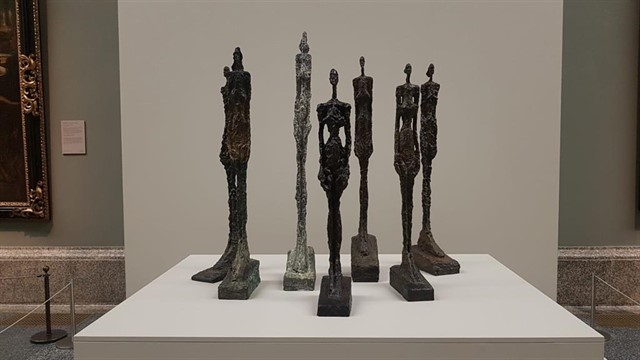
Alberto Giacometti, the sculptor best known today for his elongated human figures that seem to straddle the line between the abstract and the figurative, is currently being honoured by Madrid’s most iconic museum, the Prado Museum.
An exhibition within an exhibition
The tour begins in the gallery displaying Velázquez’s *Las Meninas*, where a group of Giacometti’s sculptures—*Tall Woman III*, *Tall Woman IV*, *Large Head* and *Walking Man*—are juxtaposed with the Spanish painter’s extraordinary masterpiece. The series of seven sculptures, ‘Women of Venice’, is displayed alongside Tintoretto’s Christ in a room adjacent to the galleries housing El Greco’s paintings. This combination draws clear parallels with Giacometti’s approach to his female figures and their exaggerated proportions. Finally, “The Leg” is exhibited alongside Zurbarán’s “Hercules” series, with its Gothic, fleshy texture that seems almost to leap off the canvas.
Giacometti, an artist ahead of his time
Born in Borgonovo, Switzerland, in 1901, Alberto Giacometti became one of the most iconic and renowned sculptors of the 20th century. He came from an artistic background; his father, Giovanni, was a Post-Impressionist painter, and from a very young age Giacometti showed a talent for art and craftsmanship. After graduating from the Geneva School of Fine Arts, he moved to Paris in 1922, where he was apprenticed to the sculptor Antoine Bourdelle (who had been a pupil of Rodin). During that period, the city was the artistic capital of the world, and Giacometti associated with figures such as Joan Miró, Max Ernst, Pablo Picasso, Bror Hjorth and Balthus, who were the leading exponents of Cubist and Surrealist art at the time. These styles were adopted by Giacometti, who was quickly regarded as one of the leading exponents of Surrealist sculpture.
Before the outbreak of the Second World War, Giacometti became interested in the figurative representation of the human head, using live models, often in exaggerated proportions.
The post-war period
After returning to Switzerland during the war, Giacometti’s work changed considerably, perhaps reflecting the profound changes taking place in other parts of the world. His post-World War II work is characterised by a shift in scale, both in sculpture and painting, an obsessive reworking of his artworks, and his public art commissions. During his lifetime, he was highly acclaimed, with an exhibition of his work at the famous Museum of Modern Art in New York.
The perfect accommodation for art lovers
Whether it’s The Principal Madrid or the Hotel Único Madrid, both within walking distance of the Prado Museum, they offer the perfect accommodation for art lovers visiting the capital. The former enjoys a prime location in Madrid at the start of Gran Vía, with its nightlife, restaurants and bars. The latter, meanwhile, is situated in the heart of the city’s most elegant district, the Salamanca district, surrounded by boutiques, museums and private galleries.
Architecture, art and gastronomy come together in these exceptional hotels, where the rooms offer the perfect retreat from which to reflect on and take in a busy day in what many consider to be the city with the most fascinating art galleries in the world. To round off a day of artistic inspiration, the cuisine of Ramón Freixa, at Atico and Ramón Freixa Madrid, will inspire you in a different, yet no less profound, way.
Did you like this article? Share it on your social media.


También te puede interesar
Stay Informed
Subscribe to our newsletter to gain exclusive access to all the latest news, benefits, and offers on stays and dining that only Único Hotels can offer you.